Reimagining the Motor

Integrating Rotor, Windings & Driver into One Compact Module

| /

Type

Description & Specifications
MotorCell high-speed PCB motor

MotorCell integrates the rotor, planar PCB windings and driving electronics into one ultra-compact coreless motor module. Its onboard sensorless controller eliminates the need for external Hall sensors.

Designed for low-torque, high-speed applications, MotorCell supports PWM speed control and works with the MotorCell library. The library provides PID-based speed control for CodeCell and other compatible ESP32 devices.

MotorCell uses the BD67173NUX three-phase back-EMF motor controller. The IN pin controls the motor using a 2.5–5V logic signal, while the OUT pin provides speed feedback. Using the MotorCell PID library, speed can be controlled in approximately 1,000 RPM increments.

If the rotor stalls, the driver enters a five-second lock-protection state. The motor can be restarted by setting the PWM input to 0% before enabling it again. This recovery is handled automatically by the library’s Spin function.

The shaftless pancake design uses a slim 3.3mm aluminium rotor containing four arc magnets, an iron backplate and ceramic-hybrid ball bearings. It can reach more than 30,000 RPM without a load and is intended for lightweight fans, robotics, kinetic art and other high-speed projects.

Each MotorCell pack includes one MotorCell, one 5-pin male header and four M1.2 screws. The soldered version is supplied with its header already installed.

  • MotorCell is intended for small, lightweight loads. Speed decreases as load and drag increase.
  • The maximum tested spinning load is 12g at a radius of 18mm.
  • The library enables a pull-up resistor on the OUT pin when reading speed. Other controllers must provide an equivalent internal or external pull-up.
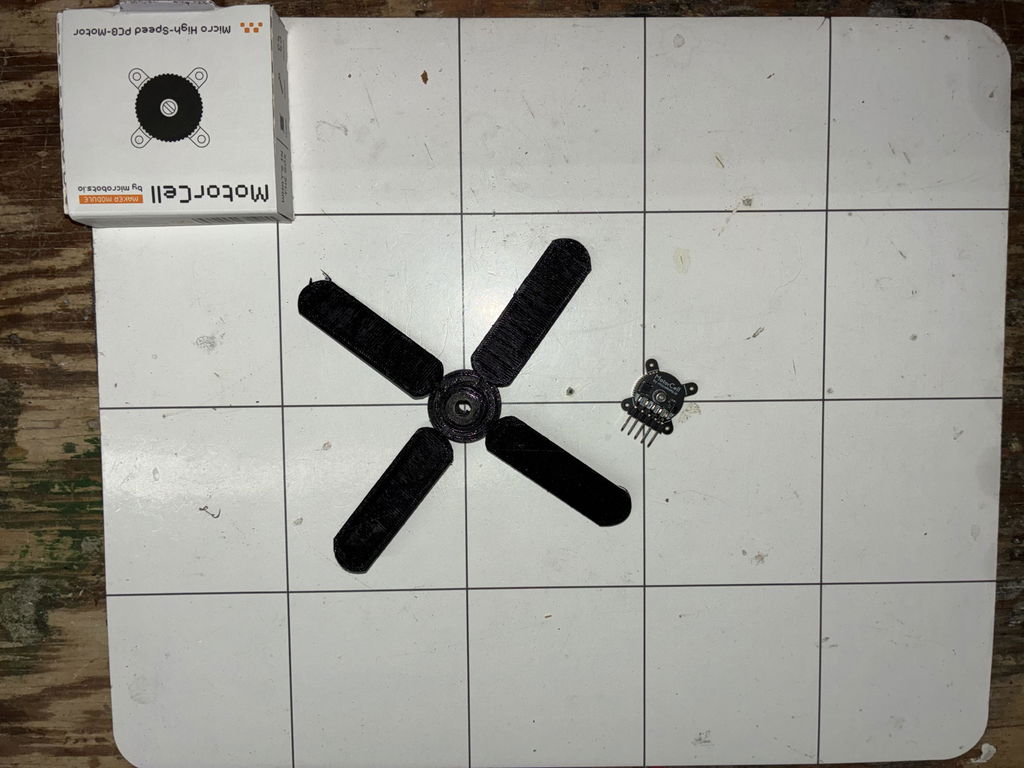
  • For press-fit 3D-printed parts, an internal diameter of approximately 16.4–16.6mm is recommended, depending on printer tolerance.
  • If adhesive is required, apply it only to the sides of the rotor teeth and keep it away from the bearing.
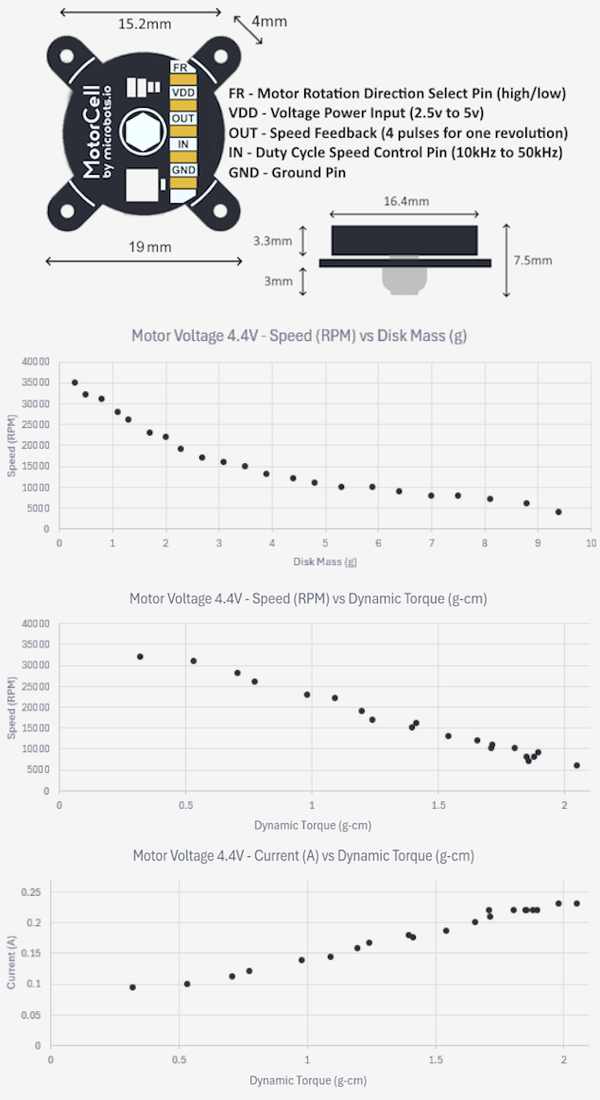
MotorCell torque and speed graph
  • Mechanical:
    • Poles: 4 magnetic poles and 6-slot windings
    • Ball Bearings: Ceramic hybrid
    • Weight: Approximately 4.0g
    • Connector Pitch: 2.54mm
    • PCB Thickness: 0.8mm
  • Electrical:
    • Motor Kv: Approximately 8,500 RPM/V
    • Maximum Power: 1.3W
    • No-load Operating Voltage: 2.5–4.2V
    • Loaded Operating Voltage: 2.5–5V
    • Normal Operating Temperature: Approximately 50°C
    • No-load Speed: More than 30,000 RPM
    • Speed Feedback Resolution: Approximately 1,000 RPM
    • Minimum Controllable Speed: Approximately 1,000 RPM

MotorCell is an electronic development module intended for integration into prototypes and DIY electronic projects. It is not a finished standalone appliance or a toy. Supporting RoHS records are maintained. The designer or manufacturer of a completed product incorporating MotorCell is responsible for assessing that finished product against all applicable safety, EMC, environmental and other regulatory requirements. For commercial product integration, please get in touch.

3D Model

Safety & Use

MotorCell is a high-speed, low-voltage electronic development module intended for DIY projects, prototypes and educational electronics. It is not a toy or a finished standalone appliance.
  • Use a regulated low-voltage DC supply and follow the specified voltage limits. Do not exceed 5 V.
  • Check the supply polarity and wiring for short circuits before applying power.
  • MotorCell can rotate at more than 30,000 RPM without a load. Secure it firmly before use, wear suitable eye protection and keep fingers, hair, loose clothing, wires and tools away from the rotor.
  • Do not hold the PCB during operation or attempt to stop the rotor by hand. Disconnect power and allow it to stop naturally.
  • MotorCell may become warm during normal operation. Allow it to cool before handling or servicing.
  • The rotor contains strong magnets. Keep it away from medical implants and magnetically sensitive equipment.
  • If disassembled, retain all components and secure the rotor correctly before reuse. The recommended shaft-tightening torque is 0.15 Nm.
  • Disconnect power before soldering, mounting, adjusting or disassembling MotorCell. Young makers should work under responsible adult supervision.
  • The screws, header, bearings and rotor components are small parts and must be kept away from young children.

When integrating MotorCell into a completed project, the maker is responsible for ensuring that its power supply, wiring, mounting, rotor attachment, guarding and operating speed are safe and suitable for the intended use.

Open Stator

PCB motors can be integrated directly into custom electronics, removing the need for a separate motor PCB. The MotorCell stator design is therefore available as an open-source design that can be incorporated into a compatible custom PCB.

Building and balancing a reliable high-speed rotor is more complex. The MotorCell rotor components can be purchased separately for use with a compatible PCB stator. When going with this option remember to verify your PCB specifications, electrical limits, rotor alignment, clearances, fastening, guarding and safe operation of the completed motor.

Design Files
Frequently Asked Questions
How do I press-fit a part onto the rotor?

MotorCell’s 3.3mm aluminium rotor includes teeth for attaching lightweight parts. For 3D-printed parts, an internal diameter of approximately 16.4–16.6mm is recommended, depending on your printer’s tolerance.

Press the part evenly onto the rotor and confirm that it is secure and balanced before applying power. If needed, apply a small amount of suitable adhesive only to the sides of the rotor teeth. Keep adhesive away from the bearing.

What is MotorCell’s speed resolution?

MotorCell uses the BD67173NUX sensorless controller and back-EMF speed feedback. With the MotorCell PID library on CodeCell or another compatible ESP32 device, speed can be controlled in approximately 1,000 RPM increments.

What is MotorCell’s minimum speed?

MotorCell is designed for high-speed, low-torque operation. Its lowest controllable speed using the onboard driver is approximately 1,000 RPM. Performance becomes less efficient and reliable at very low speeds.

Can MotorCell hold a position?

No. MotorCell is a high-speed sensorless motor and is not a servo or positioning actuator. It cannot hold or accurately control a fixed angular position.

What ages is MotorCell suitable for?

MotorCell is intended for makers, students and developers. It is not a toy and operates at very high speed. Children should use it only under direct adult supervision, including during soldering and powered testing.

How do I install the MotorCell library?

In the Arduino IDE, open “Tools > Manage Libraries,” search for “MotorCell” and install the latest version.

Example sketches can then be found under “File > Examples > MotorCell.”

How do I get started?

Tutorials and example projects are available on the MotorCell Tutorials page.

Why does MotorCell cost more than a conventional motor?

MotorCell integrates the PCB stator, precision rotor, bearings, magnets and sensorless driver into one compact module. Its price reflects the specialised components and development required for this unusual motor design. The PCB stator files are also available as an open-source design for custom projects.

Manufacturer & Shipping Information

MotorCell is stocked and shipped from Malta, European Union, and is available for international shipping to supported destinations. Available shipping methods, estimated delivery times and shipping costs are displayed at checkout. Deliveries outside the European Union may be subject to local import duties, taxes or customs fees.

Product: MotorCell
Product Revision: Revision 1
Country of Manufacture: China
Manufacturer: Microbots Ltd.
Address: Birzebbugia, Malta
Email: info@microbots.io

Product variants and SKUs:

  • Motor with Unsoldered Pins — MB-MM-MC-01
  • Motor with Soldered Pins — MB-MM-MC-02
  • Rotor Parts for Open-Source PCB Stator — MB-MM-MC-03

Things You Can Build

What's in the box?

Unbox, Power Up & Start Spinning

Image Grid

Choose a Tutorial to Kickstart your Project:

Driver Speed 3D Prints Pulse